About 7 s per minute of 720p video On a single cloud GPU, down from about 6 minutes. How it was measured
What AIM does
AIM is a shipped AI football coaching product. A player records a drill on a phone; the platform checks the footage, reconstructs what happened, separates the drill into meaningful phases and repetitions, measures technique, scores the performance, and returns visual coaching feedback.
I joined while the product's first analysis path was still rule-based. My work grew into ownership of the full intelligence layer around the product: the data engine, perception stack, spatial and temporal reasoning, domain models, biomechanics, scoring, inference services, quality controls, and the visualization shown to users.
AIM Advanced Biomechanics, production output. I built everything in it, from player and ball perception, drill phases and technique analysis to scoring and the rendered coaching story.Visit AIM.io (opens in a new tab)
What the product needed
Beyond hand-written rules
The first analysis path was rule-based. It proved the idea, but real footage has more variety than rules can cover, and separate outputs did not add up to one trustworthy account of the drill. The next step needed a shared data and model foundation.
An expensive training loop
Models trained on premium cloud hardware, so every retraining cycle had a real cost and iteration slowed down. Training had to fit a startup's budget.
Commercial readiness
Every model, weight file, and dependency had to ship under terms suitable for a commercial product, not only for research.
Slow, product-blocking inference
A one-minute drill took around six minutes to analyze. That latency did not fit a responsive coaching experience.
What I built
AIM is not one model. It is a chain of systems that must agree about the same player, ball, cones, drill structure, and scoring rules. I designed and built that chain so every stage produces a testable artifact for the next one.
Detection and pose run in parallel. Both results feed the tracking, geometry and models that produce the final feedback. A simplified view of the system I built.View full diagram (opens in a new tab)
Data and annotation engine
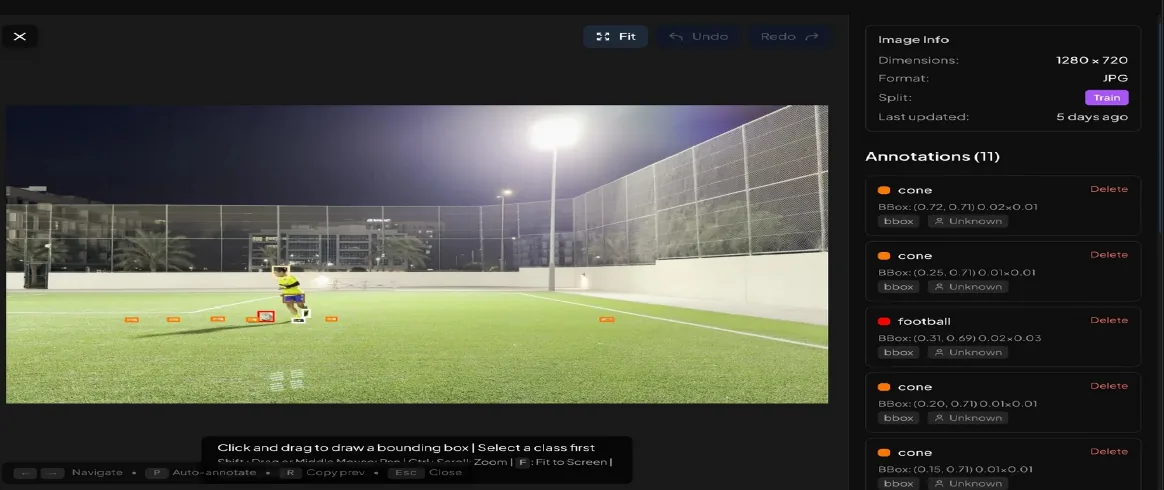
Built a dedicated annotation and dataset platform instead of treating labels as disposable files. It covers the different kinds of labels the models learn from, with review workflows, batch tools, and model-assisted labeling so each round of training data is better than the last.
The actual labeling workspace. Annotators inspect model suggestions and correct the labels used to train the perception models.View full screenshot (opens in a new tab)
Video validation and drill setup
Added the checks that make downstream analysis reliable: whether the footage is usable, whether the player, ball and drill are in view, and whether the drill was set up as intended. The system understands the drill's layout, not just the objects in the frame.
Football-specific perception
Built the visual foundation for real-world phone footage: custom-trained models for the player, ball, cones and body pose, with tracking and cleanup that hold up when the footage is far from perfect.
Movement and feature layer
Turned raw detections into consistent movement signals: where the player and ball are relative to the drill, how they move, and how the body moves with them. One shared layer feeds every downstream model, which keeps them consistent and easy to inspect.
Drill, phase and event understanding
Built specialized models that follow a drill over time: what the player is doing, where each repetition starts and ends, and what went wrong along the way. A shared training and release process turns experiments into models that can be deployed with confidence.
Biomechanics and explainable scoring
Connected body, ball and drill signals into technique measurements for every repetition, then into scores that show a player what drove the result and where to improve.
Production pipeline and speed
Connected every stage, from validation to the final report, into an asynchronous cloud pipeline, then optimized the whole path until one minute of 720p video took roughly seven seconds to analyze on a single cloud GPU.
Coach-facing visualization
Built the visual product layer that makes the analysis understandable: body overlays, player and ball trails, top-down views, live drill state, technique and score summaries, and graceful handling of uncertain or missing signals.
Commercial-ready foundation
Brought training onto far cheaper hardware, added experiment tracking and release checks, and made sure every model and dependency is licensed for commercial use.
What changed
Analysis of one minute of 720p drill footage went from about six minutes to about seven seconds on a single cloud GPU. The same models now train on far cheaper hardware. The rule-based prototype became custom models trained and evaluated on annotated drill footage, and every shipped model is cleared for commercial use.
How these were measured
Speed
Wall-clock processing time for one minute of 720p drill footage on a single cloud GPU, measured on the production pipeline. The six-minute baseline is the earlier pipeline on the same kind of footage. Times vary with frame rate and drill length.
Training cost
Model training moved from premium cloud hardware to much cheaper hardware without changing what the models are trained to do. The comparison covers training compute only; engineering time, storage, and production inference are separate.
Accuracy
No single number describes the whole stack, so none is claimed here. Each model is evaluated on held-out, human-annotated drill footage kept separate from its training data, and ships only after its deployed version is checked against the one that was evaluated.
Licensing
Every shipped model's weights and training code are under permissive licences suitable for commercial use. That is a statement about the models, not a legal opinion on the product as a whole.
My role
I was the hands-on technical owner for the intelligence layer. That meant making the model, product, and operational decisions fit together, not optimizing one component in isolation. In November 2025 I was promoted to AI Lead, overseeing model selection, feature scoping, and technical review across the project.
System architecture
Designed the path from phone upload through analysis artifacts to coaching output.
Data strategy
Built the annotation, review, dataset, and quality infrastructure behind every model.
Domain modeling
Translated football drill rules into something models can measure and score.
Model platform
Established shared training, evaluation, and release processes.
Product visualization
Designed and implemented the final visual explanation of what the system understood.
Performance and cost
Cut analysis time from minutes to seconds and moved training onto far cheaper hardware.
Commercial readiness
Drove license audits, quality gates, documentation, deployment, and technical handoff.
Technical leadership
Scoped features, reviewed contributions, and translated engineering tradeoffs for stakeholders.
Need something like this?
I build connected AI products like this: the data, models, domain logic, deployment, and user experience needed to turn an ambitious idea into something people can trust. To test a sports idea first, start with a one- to two-week feasibility sprint.