Specialized AI applications
Products where task-specific classifiers, sequence models, retrieval, assistants, or carefully bounded LLM components must outperform a generic wrapper.
For teams that need more than a trained model. I design and build the whole product around it: data and annotation, evaluation, models and domain logic, the web app, API, and database, optimized inference, monitoring, and a handoff your team can own.
AI projects often fragment at the boundaries: labels do not match product semantics, offline metrics do not reflect user value, model outputs need brittle postprocessing, infrastructure decisions arrive too late, and nobody owns the final experience.
I work across those boundaries. The architecture starts with the decision the product must make and the evidence users need to trust it. Models, rules, geometry, services, interfaces, and operational safeguards are then designed as one system rather than handed between disconnected specialists.
Products where task-specific classifiers, sequence models, retrieval, assistants, or carefully bounded LLM components must outperform a generic wrapper.
Multi-stage systems combining detection, segmentation, pose, tracking, geometry, temporal models, and downstream business logic.
Products that must turn raw footage into reliable events, movement features, biomechanics, scores, recommendations, or visual feedback.
Web products where the AI feature needs the rest of the product built too: the interface, API, database, accounts, and the everyday workflows people use it in.
Define the user decision, constraints, evidence, product boundary, milestones, and the first risk that must be retired.
Establish data, annotation, evaluation, architecture, and a thin end-to-end path before scaling individual components. Within six weeks of the start you have a first working version: your model running on your own data, behind an app your team can try.
Improve model quality, domain reasoning, performance, failure handling, monitoring, and integration against real inputs.
Deploy, document decisions and operations, validate product behavior, and leave the team with ownership rather than dependency.
We agree on the goal, the acceptance criteria, and the price of the milestone.
A demo on your own data against those criteria, with the code, model files, and documentation in your repository.
Continue, change the plan, or stop. You pay per milestone, and if you stop, you keep everything delivered.
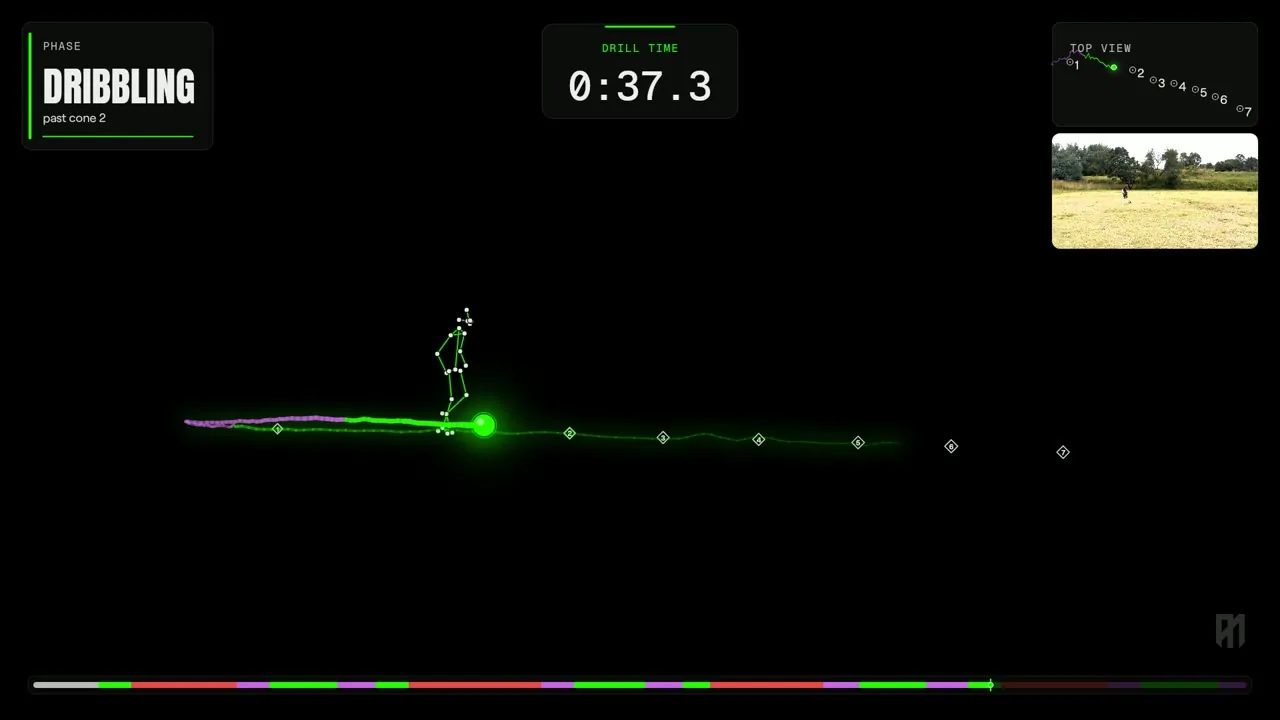
For AIM, I built the connected path from football video and annotation through filming validation, player and ball perception, cone geometry, temporal phase and repetition models, biomechanics, scoring, optimized inference, APIs, quality controls, and the final visualization. The shipped product works because those components share one domain model and one product goal.
I handle technical discovery, architecture, implementation, measurement, and stakeholder communication. Decisions do not disappear through an account-management layer.
Code, documentation, model artifacts, operating knowledge, and decision context are delivered for long-term ownership. The goal is a product capability, not permanent consultant dependence.
Yes. The interface, API, database, accounts, and integrations can be part of the same build, designed with the AI feature rather than bolted on afterward. When a build needs two engineers, I bring in Frusto Labs, the two-person studio I work with, and you still deal with me directly.
Yes. I can own the intelligence layer while working with existing product, backend, frontend, mobile, or platform engineers. Responsibilities and interfaces are made explicit during scoping.
No. The product outcome and constraints should be clear enough to scope discovery. Model and architecture choices are engineering outputs, not prerequisites the client has to provide.
The work is split into milestones, each with acceptance criteria and its own price. You pay per milestone and can stop after any one, keeping everything delivered. The first milestone targets the highest technical risk, so the project can change direction before downstream work becomes expensive.
Yes. A build can include a defined stabilization period, follow-on feature milestones, or support for the internal team. The preferred model is still explicit scope and ownership rather than indefinite ambiguity.
Send me the current product, data, team, constraints, and the capability you want to ship. I’ll reply personally within one business day with the questions that determine a sensible first scope.
Work directly with Jude Mingay, a freelance AI product engineer based in Freiburg, Germany. Remote projects worldwide; English, German, or Portuguese.