Performance has plateaued
More training runs are not moving the real product metric, and the team is no longer sure whether the bottleneck is data, model choice, or evaluation.
A measured technical audit for teams with a promising prototype that is not yet a dependable product. I trace the system from data and evaluation through models, runtime, infrastructure, and integration, then prioritize the fixes that will change the outcome.
Low accuracy may come from label semantics, preprocessing, postprocessing, validation leakage, or an evaluation set that does not represent the product. Slow inference may come from data movement and orchestration rather than the network itself. High cloud cost may be a batching, scheduling, or architecture problem.
The audit treats the pipeline as a system. The goal is not a list of generic best practices; it is a defensible explanation of where performance is being lost, what each fix is likely to change, and which work is worth doing first.
More training runs are not moving the real product metric, and the team is no longer sure whether the bottleneck is data, model choice, or evaluation.
Latency, throughput, memory, GPU utilization, or cloud cost prevents the system from meeting its intended user experience.
Edge cases, deployment drift, licensing, hidden manual steps, or tightly coupled services make every release risky and difficult to reproduce.
Agree on the product constraint: accuracy, latency, throughput, cost, reliability, or a weighted combination.
Run the current system on representative inputs and make the baseline observable from end to end.
Profile, slice, benchmark, and test the highest-probability causes rather than optimizing by instinct.
Deliver measured findings and an implementation order based on impact, risk, dependency, and effort.
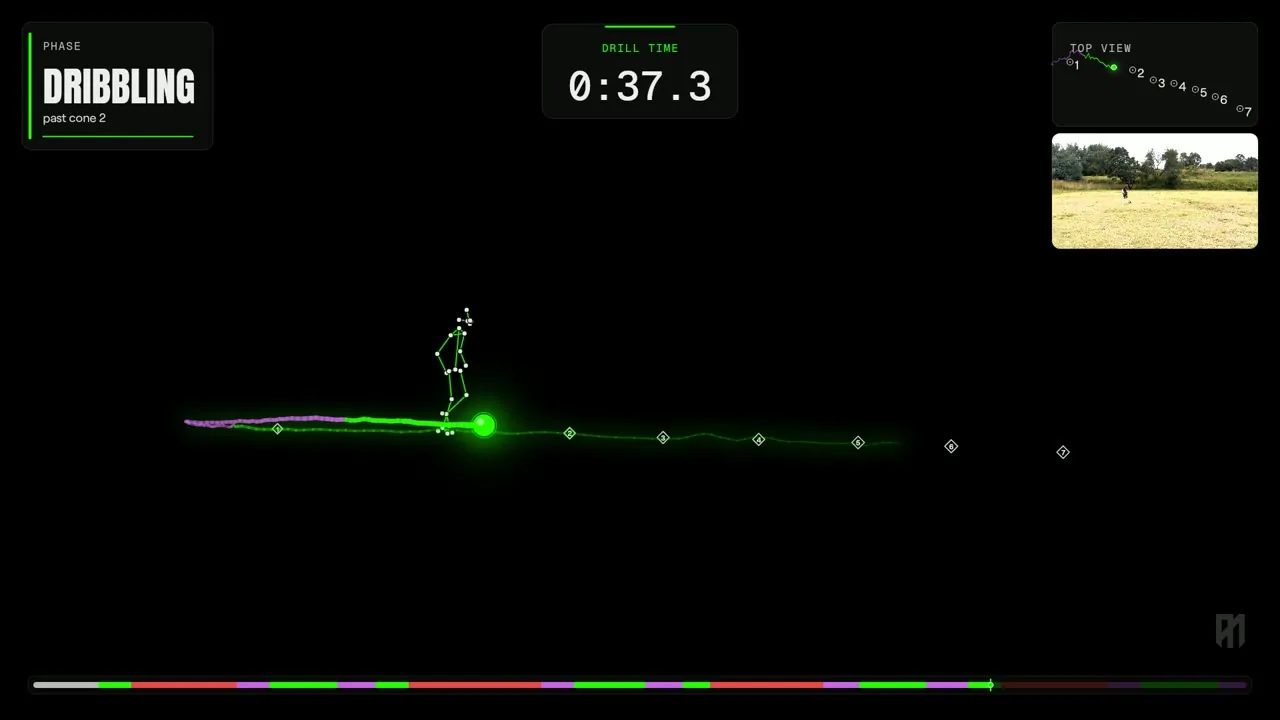
AIM’s football analysis evolved from an early prototype into a joined-up production system that analyzes one minute of 720p footage in about seven seconds on a single cloud GPU. The work combined better data and task definitions with model changes, inference optimization across the whole path, cheaper training, licensing review, and reliable postprocessing. The result did not come from swapping one model.
Usually, yes, at least to the parts on the critical path. The access level can be narrowed, read-only, and time-limited. If code access is impossible, a useful architecture and evidence review may still be possible, but the conclusions will be less direct.
Yes. The audit is about the system, not assigning blame. I document assumptions, reproduce behavior, and make findings reviewable so the existing team can challenge or implement them.
The engagement includes targeted validation of key findings, not an open-ended rewrite. I can implement the prioritized work afterward, or hand the measured backlog and supporting evidence to your team.
No. Computer vision and multi-stage sports pipelines are a particular strength, but the same audit approach applies to specialized classifiers, LLM-backed applications, temporal models, and other production ML systems.
Send me the current architecture, the metric that matters, and what the team has already tried. I’ll reply personally within one business day with an honest view of whether an audit is the right next step.
Work directly with Jude Mingay, a freelance AI product engineer based in Freiburg, Germany. Remote projects worldwide; English, German, or Portuguese.