New product concept
You know the athlete or coach outcome you want, but need to determine whether existing footage and sensors can support it.
A focused technical sprint for teams considering a sports AI, video-intelligence, or biomechanics product. We test the riskiest assumptions against your real footage and constraints, then turn the evidence into a buildable plan.
A convincing demo can still fail when the camera moves, the ball becomes tiny, players overlap, lighting changes, or the model has to run within a real latency and cost budget. Sports video adds geometry, time, domain rules, and filming behaviour on top of the usual machine-learning uncertainty.
The sprint is designed to surface those constraints early. Instead of producing a broad strategy deck, I work directly with representative data, isolate the riskiest technical assumption, and generate enough evidence to make the next investment decision confidently.
You know the athlete or coach outcome you want, but need to determine whether existing footage and sensors can support it.
A proof of concept works on selected examples, but nobody has tested filming variation, edge cases, or product-scale constraints.
You need an independent view of available models, licensing, infrastructure, data requirements, and what truly needs custom development.
Define the user outcome, current assumptions, available evidence, and the decision the sprint must support.
Review representative footage, labels, product constraints, hardware, privacy, and acceptable failure modes.
Build or benchmark the smallest technical slice that can validate or invalidate the central assumption.
Present findings, failure cases, architecture, risks, and a practical recommendation for what happens next.
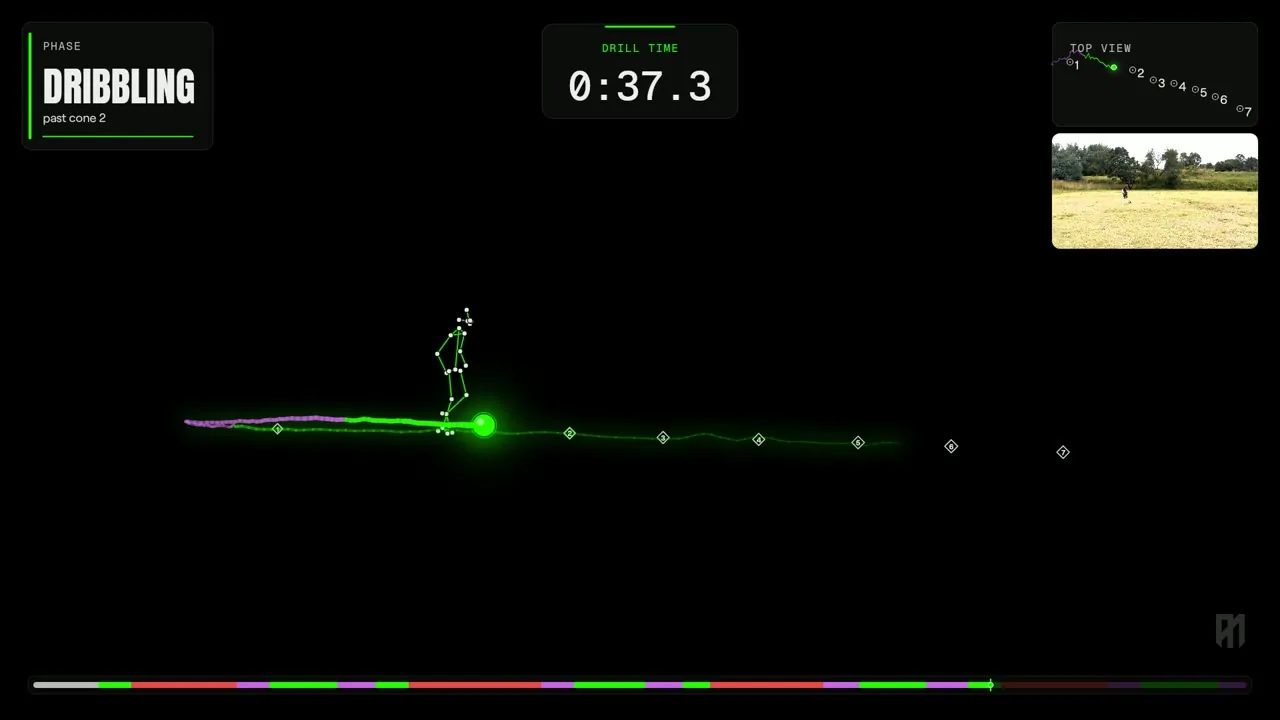
For AIM, the production problem extended far beyond choosing an object detector. Reliable coaching required filming validation, player and ball perception, cone geometry, temporal phase and repetition models, biomechanics, scoring, optimized inference, and a visualization users could understand. That joined-up product perspective is what I bring to feasibility work.
No polished dataset is required, but representative examples help. Raw clips, user recordings, prototype outputs, or even a precise filming concept can be enough to determine what evidence needs to be collected first.
The goal is a decision, not a disguised full build. Any code is a focused spike or benchmark used to test risk. If the evidence supports moving forward, the architecture and roadmap define how that work becomes production software.
That is still a successful outcome if discovered early. The recommendation may narrow the promise, change the filming setup, introduce a human review step, require more data, or stop the build before it consumes a larger budget.
Yes. It can stand alone, support another team, or become the first stage of an end-to-end product build. You retain the findings and roadmap regardless of who implements them.
Send me the product idea, the data you have, and the part you trust least. I’ll reply personally within one business day with an honest view of whether a sprint is the right next step.
Work directly with Jude Mingay, a freelance AI product engineer based in Freiburg, Germany. Remote projects worldwide; English, German, or Portuguese.